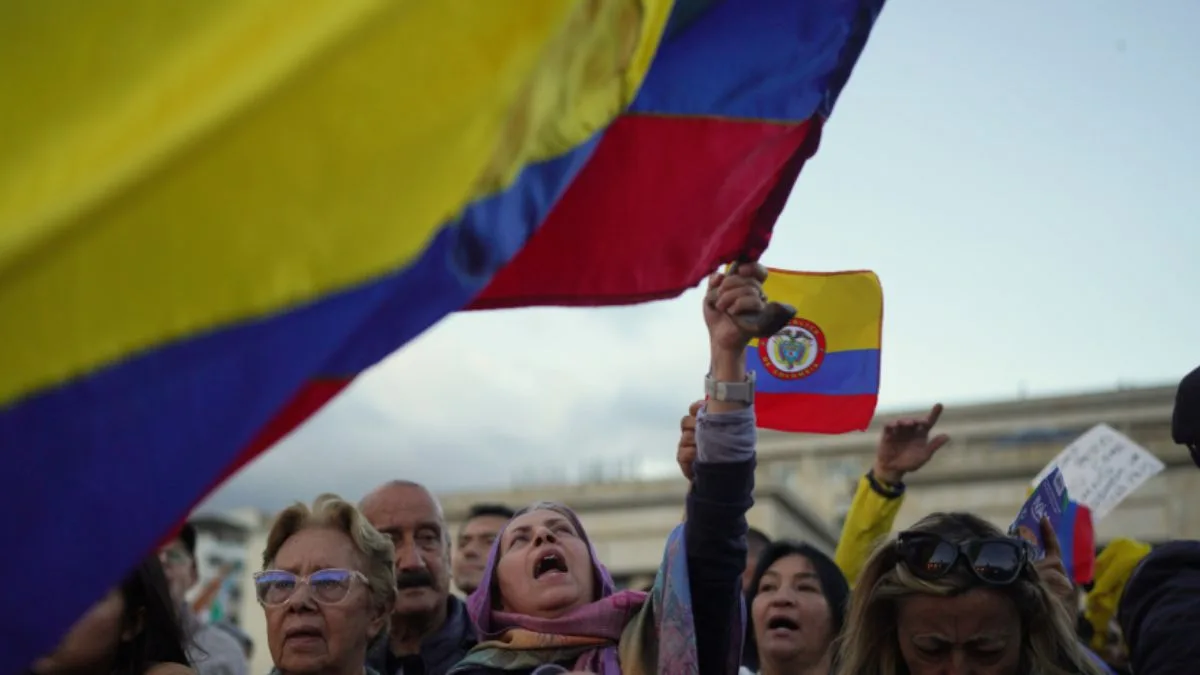
Colombia held first round of its presidential election on May 31, 2026. The result was a surprise. A far-right outsider candidate came first. A leftist senator came second. The two will now face each other in runoff on June 21, 2026. The winner takes office on August 7.
Why is this election happening?
Colombia’s current president, Gustavo Petro, cannot run again. The country’s constitution bars any president from serving two consecutive terms. Petro, elected in 2022, was Colombia’s first left-wing president since independence in 1810. His four years in office have been deeply divisive.
Advertisement
Supporters credit him with raising the minimum wage, pushing labour reforms, and trying to reduce inequality. Critics point to rising corruption scandals, surge in violence, record cocaine production under his watch. His “total peace” policy, which involved ceasefires and talks with armed groups including guerrillas and drug cartels, is seen by many as a failure.
Who were the main candidates?
Three candidates dominated the race.
Abelardo de la Espriella is a 47-year-old lawyer from Barranquilla. He ran under the Defenders of the Motherland movement and had no prior elected experience. He positioned himself as a tough-on-crime nationalist. Supporters compare him to El Salvador’s Nayib Bukele and, in some ways, to US President Donald Trump. He promised to restart aerial spraying of coca fields with glyphosate, take a harder line against criminal groups, cut taxes, expand oil exploration, and build closer ties with the United States and Israel. He had no party machine behind him and ran largely as an outsider.
Iván Cepeda is a sitting senator and the candidate of the ruling Historic Pact coalition, which is President Petro’s political group. He broadly supports Petro’s policies, including continued negotiations with armed groups. Critics have accused him of being too soft on coca cultivation and criminal networks, which he disputes. He is seen as less personally abrasive than Petro but ideologically similar.
Paloma Valencia was the third major candidate, running for the Democratic Center party. She is a senator and a protégé of former president Álvaro Uribe, who governed Colombia from 2002 to 2010. She took a centre-right position, proposing to modernise Plan Colombia, a security programme that once received major US support. And, she failed to make it to the runoff.
What happened on May 31?
More than 23 million Colombians voted, a turnout of about 56% of registered voters.
De la Espriella came first with over 10 million votes. Cepeda came second with close to 9 million votes. Valencia received less than 7% of the vote and was eliminated. Around 400,000 people cast blank ballots, and another 240,000 cast invalid ballots. Electoral authorities said the day passed without major incident.
The result surprised many observers. Pre-election polls had suggested Cepeda would finish first. De la Espriella’s strong lead in the first round was not widely predicted.
After the results came in, former president Uribe announced his support for De la Espriella ahead of the June 21 runoff. Other right-wing leaders also moved to back him.
President Petro responded to the results by claiming irregularities in the vote count, alleging that hundreds of thousands of votes were added without evidence. Electoral authorities did not confirm any such problems.
The runoff: What happens next?
The June 21 runoff is now a direct contest between De la Espriella and Cepeda. It is a fight between two very different visions for Colombia.
De la Espriella represents a sharp break from Petro’s government. He wants to end peace talks with armed groups and take a militarised approach to crime and drugs. He speaks positively of Trump and has signalled he will align Colombia more closely with Washington.
Cepeda represents continuity with the current government. He wants to carry on negotiations with guerrillas and criminal groups, and maintain Petro’s social programmes. He is considered a more moderate personality than Petro but shares his political direction.
For De la Espriella to win, he needs to hold his lead while picking up votes from supporters of Valencia and other eliminated candidates. For Cepeda, the task is to consolidate the left-wing vote and attract centrist voters who may be uneasy with De la Espriella’s style and rhetoric.
Why does this matter beyond Colombia?
Colombia is the world’s largest producer of cocaine. The next president’s approach to drug policy will directly affect drug flows into the United States and Europe.
Under Petro, coca cultivation and cocaine production hit record highs. He de-emphasised crop eradication. De la Espriella has promised a return to aggressive eradication, including aerial spraying. Cepeda has indicated a softer approach.
The United States is Colombia’s largest economic partner and a major source of security aid. The relationship became strained under Petro. Both Valencia and De la Espriella had pledged to join Trump’s Americas Counter Cartel initiative. Cepeda’s position on this is less clear. Petro visited White House in February 2026 and made concessions on drug interdiction. But tensions are not at ease.
Political violence also shaped this election. A presidential candidate was assassinated in June 2025. Other candidates received serious threats. De la Espriella spoke at his final campaign rally from behind bulletproof glass.
What does this mean for Colombia?
The country is deeply polarised. Whoever wins on June 21 will face a fragmented parliament with no single party holding a majority. The next president will need to build coalitions to pass legislation.
If De la Espriella wins, Colombia would shift sharply to the right, ending the left’s hold on the presidency. If Cepeda wins, the left continues in power for another four years, though without the same confrontational style as Petro.
The June 21 vote will decide which direction Colombia takes on crime, drugs, the economy, and its relationship with the United States. The margin in round one was close. The runoff could go either way.